An independent analysis of JFK’s 1963 Berlin address: the Wall, Cold War solidarity, famous German phrase, rhetoric and historical limitations.
In this article 10 sections
- Why Kennedy came to West Berlin in 1963
- The meaning of “Ich bin ein Berliner”
- How the speech defines political freedom
- Repetition as an invitation to witness
- The role of the Wall in the message
- Diplomacy, reassurance and political constraints
- What changed afterward?
- A practical rhetorical lesson
- Frequently asked questions
- Read the original and compare related speeches
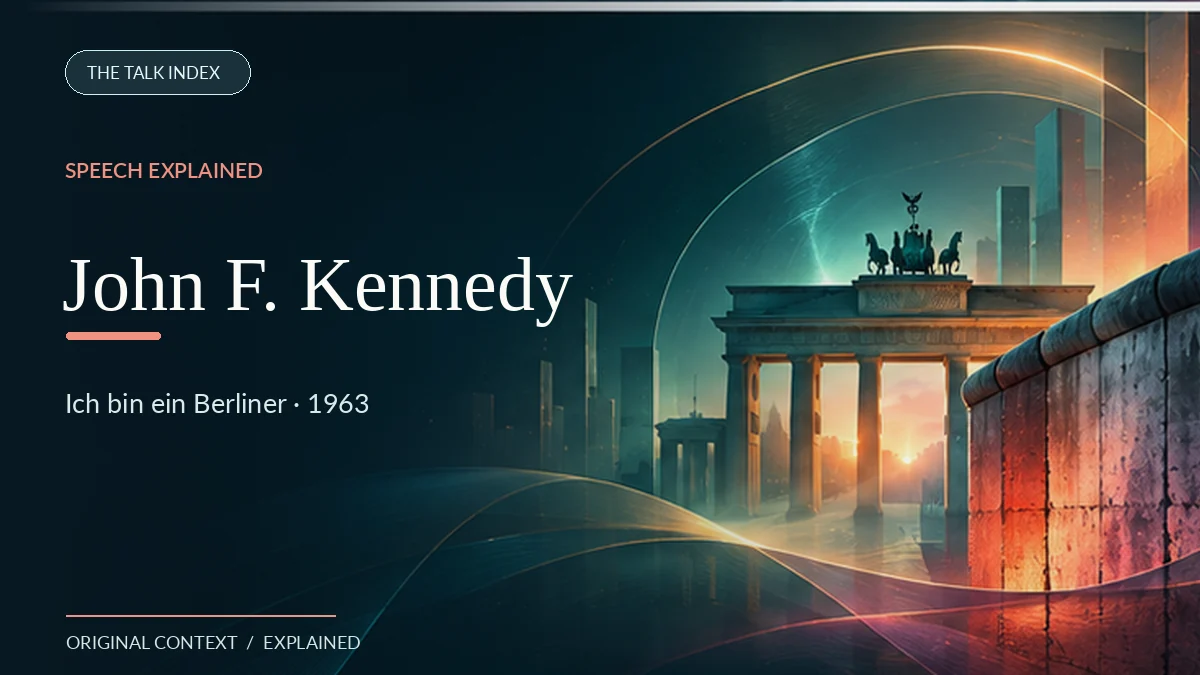
On June 26, 1963, President John F. Kennedy addressed a large crowd at Rudolph Wilde Platz outside West Berlin’s city hall. The speech is remembered for the phrase Ich bin ein Berliner, but its historical significance depends on the situation that gave those words force: a divided city, a Cold War confrontation, and residents living beside a recently built wall.
This guide analyzes Kennedy’s West Berlin address, not his separate speech later that day at the Free University of Berlin. The American Presidency Project transcription of the exact remarks, the U.S. State Department historical note, and JFK Library archival photographs document the event.
Why Kennedy came to West Berlin in 1963
After World War II, Germany was divided, and Berlin itself occupied a strategically fragile position. West Berlin was surrounded by East German territory. The Berlin Wall, erected in 1961, had sharply restricted movement between the two parts of the city. Kennedy’s visit signaled American political backing for West Berlin at a time when security guarantees, access routes, and competing claims about freedom carried immediate consequences.
The State Department record shows that Kennedy made multiple stops in West Berlin that day, including Checkpoint Charlie and a later appearance at the Free University. The famous words belong to the Rudolph Wilde Platz remarks. Distinguishing those events prevents a common historical error: combining excerpts from several Kennedy speeches into one continuous transcript.
The meaning of “Ich bin ein Berliner”
Kennedy used the German phrase as an expression of solidarity. He was not making a legal claim about citizenship or telling the audience that their difficulties were identical to the lives of Americans. He was asking listeners to imagine political freedom as a shared moral concern that crossed national borders. By speaking a short phrase in the audience’s language, he brought an abstract alliance into the room.
The phrase is sometimes surrounded by the persistent “jelly doughnut” anecdote. That joke distracts from the speech’s actual rhetorical function and is not a sensible substitute for historical analysis. The significant question is why a foreign head of state chose to identify himself publicly with a divided city, knowing the words would be quoted far beyond the audience present.
How the speech defines political freedom
Much of Kennedy’s case is built on an observable contrast between political systems. Rather than offering a long theoretical definition of democracy, he invites people who are uncertain about the Cold War to look at Berlin. His implication is that the city’s physical divisions and restrictions on movement made the consequences of political control visible.
This is powerful persuasion, but it is also a selected frame. A speech made for solidarity will highlight evidence that strengthens the message and leave less time for complicated debates over Allied policy, German history, or domestic tensions within Western democracies. Readers should therefore treat the address as primary evidence of a president’s position, not as a neutral encyclopedia of the Cold War.
Repetition as an invitation to witness
The address repeats an invitation to come to Berlin, presenting the city as an answer to competing political arguments. The technique is unusual because it turns the location itself into the central piece of evidence. It asks audiences to judge political systems by practical consequences, including who can travel, speak, and govern their lives.
In modern public speaking, this is a lesson in using concrete examples rather than only values-language. A speaker discussing a policy can describe the people, institutions, or observable outcomes affected by it. The example should genuinely illuminate the argument, however, not be chosen solely because it is emotionally effective.
The role of the Wall in the message
The Berlin Wall was not merely scenery. By 1963 it had become a material border separating families, workplaces, and communities. Kennedy’s reference to the situation would have resonated with people who encountered that border personally. The speech communicates that a barrier can be both a local hardship and an international symbol.
That symbolism helped produce a memorable news event. But walls and borders are not interchangeable across history: different structures arise under different laws, conflicts, and human conditions. The responsible comparison is to examine their specific histories and effects rather than borrowing the emotion of the Berlin speech to settle unrelated contemporary debates.
Diplomacy, reassurance and political constraints
Kennedy’s audience included local residents, German leaders, Soviet observers, and people following the visit through international media. Reassuring West Berlin was part of the speech’s purpose. Yet words alone could not determine how a crisis would unfold. Allied military arrangements, diplomatic channels, domestic politics, and the risks of escalation remained central to policy.
A cautious interpretation distinguishes a symbolic commitment from an operational guarantee. Kennedy’s rhetoric underscored solidarity, but it did not remove the need to manage Cold War confrontation. This distinction is relevant to contemporary discussions of security speeches: credibility depends on institutions and actions as well as language.
What changed afterward?
Berlin remained divided for more than two decades after Kennedy’s visit. The Wall came down in 1989, and German reunification followed in 1990. Those outcomes cannot be attributed to a single American speech. They involved economic and political changes, civic activism, international diplomacy, and decisions by authorities on both sides of the Iron Curtain.
The speech nevertheless survived as a symbolic statement about freedom and alliance. Its historical power comes from its particular moment: the words were delivered when the Wall was a daily reality, not after the conflict’s outcome was known. Read retrospectively, the address may look like a prediction; at the time, it was a public commitment made under uncertainty.
A practical rhetorical lesson
To analyze a famous speech fairly, list its audience, the problem the speaker describes, the evidence selected, the conclusion asked of listeners, and what important facts lie outside the address. Then identify one phrase that translates a large issue into an emotionally intelligible image. Kennedy’s use of the city and a simple German sentence shows how place and language can make diplomacy personal.
A speaker can adapt that structure for civic or organizational communication without copying the political message: begin with a situation the audience understands, explain why it matters, state the responsibility being assumed, and invite a concrete next step. The goal is clarity rather than manipulation.
Frequently asked questions
When and where was the Berlin speech delivered? June 26, 1963, at Rudolph Wilde Platz outside West Berlin city hall, not at the Free University of Berlin.
What did the famous German line communicate? A statement of public solidarity with West Berliners during the Cold War.
Did the address cause the Berlin Wall to fall? No. The Wall fell in 1989 through a much broader historical process.
Read the original and compare related speeches
For the original text, consult the American Presidency Project’s June 26, 1963 record. For event chronology, use the State Department historical record. For Kennedy’s different rhetorical purposes in a domestic setting, see our 1962 Rice University Moon speech guide.
Explore the original material
Our editorial notes summarize and interpret a separately published recording or official text. For exact wording and fuller context, use the original source below.
The American Presidency Project — June 26, 1963 original address